
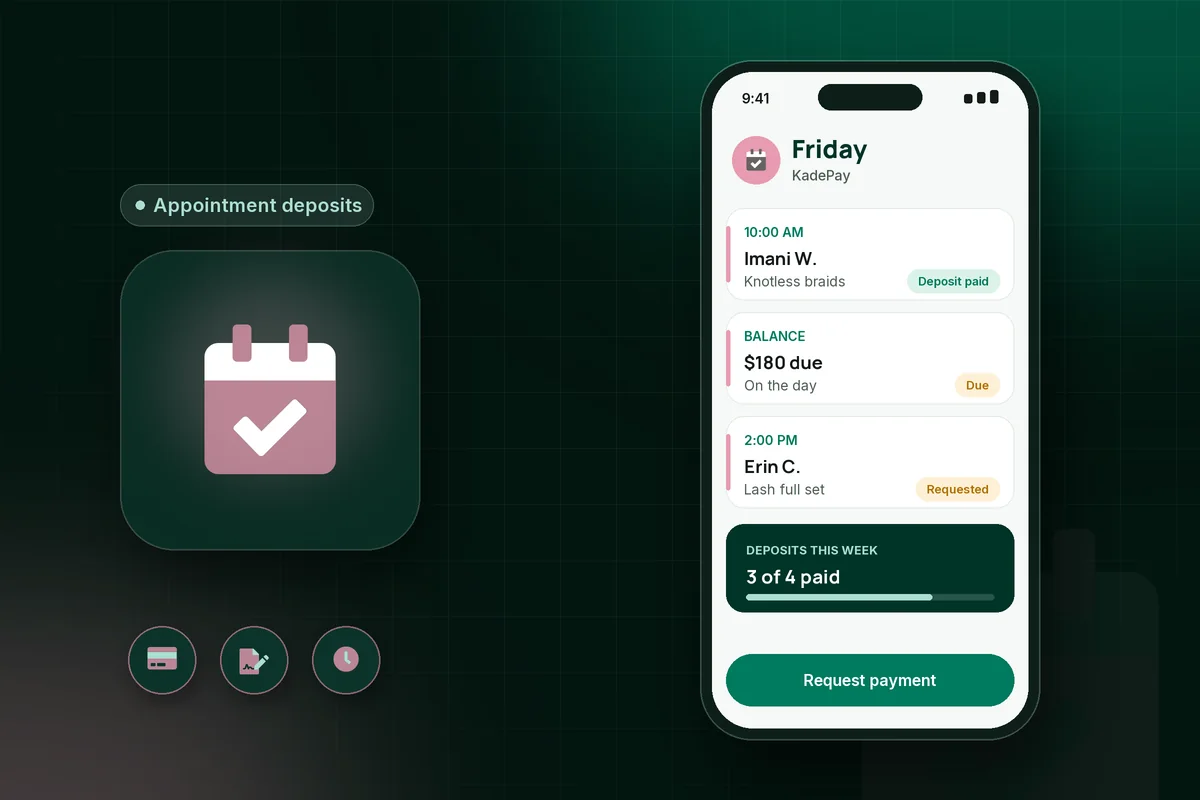
A non-refundable deposit is money a client pays up front to hold an appointment, which you keep if they cancel late or do not show. When they do show, it comes off the final bill, so a client who keeps the appointment pays nothing extra.
A non-refundable deposit turns a booking from a maybe into a commitment. It is one tool among several for cutting no-shows; the guide to reducing salon no-shows covers reminders, confirmations and rebooking habits. This post goes deeper on the deposit itself.
Deposit vs no-show fee vs cancellation fee
A deposit is collected before the appointment, while a no-show fee and a cancellation fee are charged after the client misses or cancels. That timing difference decides how easy each one is to collect.
| Non-refundable deposit | No-show fee | Late cancellation fee | |
|---|---|---|---|
| When you collect it | At booking, before the slot is held | After the client fails to arrive | After the client cancels inside your notice window |
| What triggers it | Booking the appointment | Not showing up | Cancelling too late |
| If the client shows up | Comes off the final bill | Not charged | Not charged |
| How you get paid | Client pays up front | Saved card the client authorized, or an invoice | Saved card the client authorized, or an invoice |
| Collection risk | Low, money is already in hand | Higher, card may fail or client may not pay | Higher, same as a no-show fee |
Many solo pros use the deposit as their no-show and late cancellation charge in one: keep the deposit, and charge nothing more.
When beauty pros use a deposit
A deposit makes the most sense when one missed appointment costs you a large part of your day. Common cases:
- Long services. Knotless braids, locs retwists, sew-ins and extension installs can take most of a day. A no-show can leave that time empty with no realistic way to refill it.
- Lash full sets and nail sets. A two to three hour full set is hard to fill at short notice.
- Services needing product bought in advance. If you buy hair, lashes or color for a specific client, the deposit can cover that cost.
- Bridal and events. Brides often hold a date months out. A deposit, sometimes called a retainer, holds that date.
- New clients. Some pros ask only new clients for a deposit and drop it for regulars with a good record.
To see what missed appointments cost you over a year, run your numbers through the free no-show calculator.
How much should a non-refundable deposit be?
A deposit should be large enough that a client thinks twice before skipping, and small enough that it does not scare off a fair booking. Most pros pick one of two approaches.
- Flat amount. One set amount per service or per tier. Simple to explain, and easy for a client to remember.
- Percentage. A share of the service price, so long services carry a bigger deposit. This scales on its own when you raise prices.
Illustrative example (not a recommended rate): The deposit always comes off the final bill. Balance due = service price minus deposit.
| Service | Price | Deposit approach | Deposit | Balance due at appointment |
|---|---|---|---|---|
| Knotless braids | $240 | 25% | $240 x 0.25 = $60 | $240 - $60 = $180 |
| Lash full set | $150 | Flat $40 | $40 | $150 - $40 = $110 |
| Bridal hair and makeup | $600 | 30% retainer | $600 x 0.30 = $180 | $600 - $180 = $420 |
Say on the receipt or confirmation that the deposit has been applied, so the client sees they are not paying twice.
How to write a salon deposit policy
A good salon deposit policy states the amount, what it covers, the notice window and what happens in each case, in plain words. Adapt the sample below and replace everything in brackets.
[BUSINESS NAME] deposit and cancellation policy
A deposit of [AMOUNT or PERCENT] is required to book [SERVICES]. Your appointment is confirmed only after the deposit is paid. The deposit is applied to your service total.
Deposits are non-refundable. If you need to reschedule, contact us at least [NUMBER] hours before your appointment and your deposit will move to your new date one time. Changes with less than [NUMBER] hours' notice, or a missed appointment, mean the deposit is kept.
If you arrive more than [NUMBER] minutes late, we may shorten your service or treat the appointment as missed.
If [BUSINESS NAME] cancels or reschedules your appointment, your deposit will be refunded in full or moved to a new date, your choice.
By paying the deposit, you agree to this policy.
Before you use it, review the wording yourself, and check the consumer rules where you work. Some places limit fees that are out of proportion to your actual loss. This is general information, not legal advice.
Chargebacks: keep proof the client agreed
A non-refundable deposit can still be disputed, so your best protection is clear proof that the client saw and accepted the policy before paying. A dispute (also called a chargeback) is when the cardholder asks their bank to reverse a payment.
According to Stripe's dispute documentation, when a card payment is disputed, Stripe takes the disputed amount plus a dispute fee from your balance, and the cardholder's bank decides the outcome. Card networks typically allow disputes within 120 days, and for a future appointment the window generally starts on the appointment date, not the day the deposit was paid.
For services booked in advance, Stripe's evidence guidelines say a cancellation policy can be material. They suggest submitting the policy text as the customer saw it, an explanation of how and where you showed it before purchase, and your messages with the client. In practice, that means you should keep:
- The policy text, dated, as it appeared when the client paid
- A signed form or a written "I agree" from the client
- The confirmation and reminder messages you sent
- Any messages about cancelling or rescheduling
How to collect a deposit in KadePay
In KadePay, a deposit is part of the bill. Clients use your booking link to request a time, and you review and confirm each request. You can collect the deposit in three ways:
- At booking. The client pays for the slot when they book. If the service ends up costing more, bill the difference after the appointment.
- A deposit-only bill. Send a bill for just the deposit, and confirm the appointment once it is paid.
- Part of a larger bill. For a big service, send the full bill and let the client pay a portion of it now as the deposit.
Whichever you use, make sure the client sees your policy before paying.
On the Team and Pro plans, you can send an expiring payment link to set a deadline. When a link expires, the appointment is not cancelled automatically. Check unpaid requests yourself, then decide whether to release the time.
To keep proof of agreement, you can put your policy in a signature form. KadePay keeps the signed response with the client record; clients sign in to complete forms.
If you want to charge a saved card for a no-show or late cancellation, the client must have authorized it and agreed to the policy first. KadePay does not spot no-shows or charge fees automatically. You decide, and you run the charge.
What KadePay sees pros get wrong with deposits
These are patterns the KadePay team hears from beauty pros, not survey results.
- The policy lives only in a DM. A message thread is hard to find months later when a dispute arrives.
- No transfer rule. "Non-refundable" with no reschedule window makes a client who gives a week's notice feel cheated.
- Holding the slot before the money lands. A promise to pay "tonight" is not a deposit.
- Keeping the deposit when the pro cancels. It damages trust and is hard to defend.
- Applying the policy only to some clients. Inconsistent enforcement makes the rule look personal.
For more tactics beyond deposits, see the reduce no-shows resource.
When a deposit is not the right fit
A deposit can cost you more than it saves if most of your work is short, walk-in or easy to refill. A quick barber cut or brow wax with a waitlist rarely justifies the friction. Long-term regulars with a clean record may also see a deposit as a sign you do not trust them. In those cases, reminders and a written cancellation policy may be enough.
If you are ready to take deposits alongside your bookings, you can start free with KadePay. The $0 monthly plan includes 60 booked appointments each month, then $0.15 per appointment; usage and payment fees apply.
Related reading
Sources
- Stripe, How disputes work, accessed November 4, 2026.
- Stripe, Dispute reason code categories, accessed November 4, 2026.