
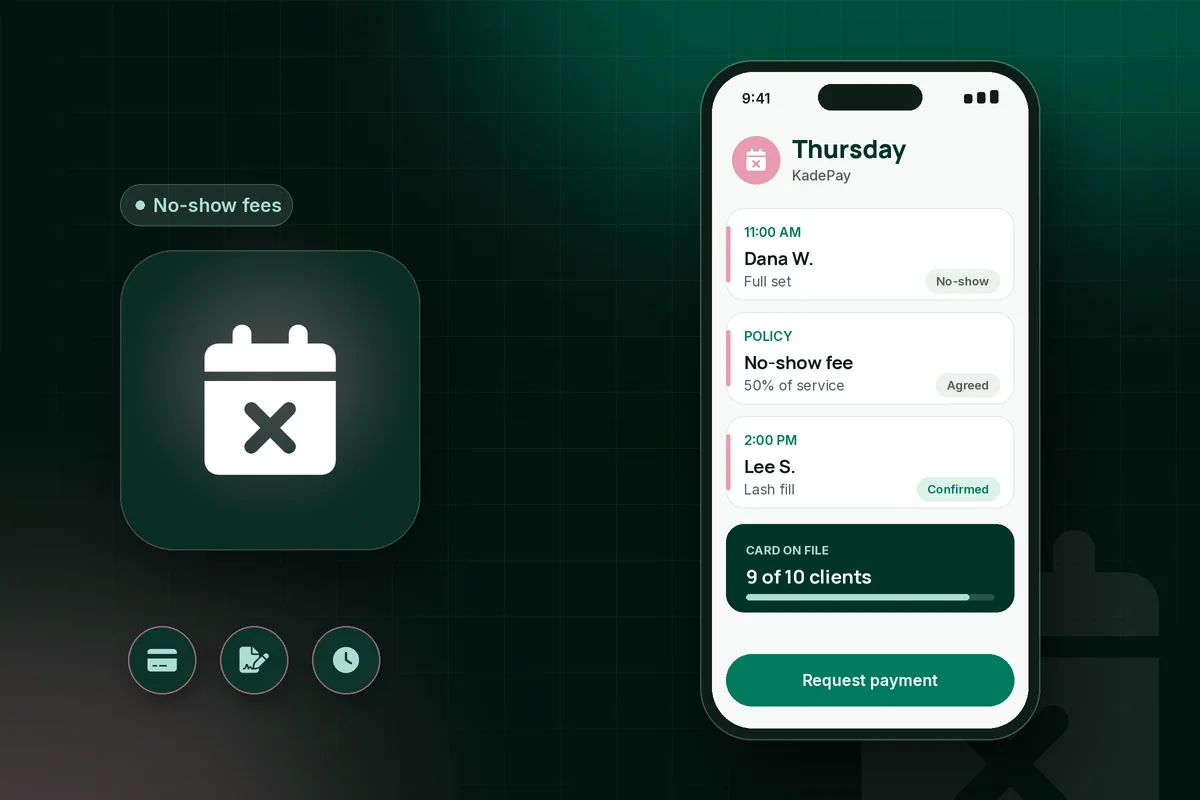
A no-show fee is a charge a client agrees to pay if they miss an appointment without notice. Set it as a flat amount, a percentage of the service or the full price, write it into a policy the client sees and accepts before booking, and only charge a payment method they have authorized.
A no-show fee is one of several tools against missed appointments. If you would rather collect money before the visit, the non-refundable deposit guide covers deposits in depth. For reminders, confirmations and rebooking habits, see how to reduce salon no-shows. This post is only about the fee charged after a missed visit.
What is a no-show fee?
A no-show fee is a charge for an appointment the client neither attended nor cancelled in time. It is collected after the fact, which is the main difference from a deposit.
That timing has a cost. With a deposit, the money is already in hand. With a no-show fee, you need a way to collect it later: a card or other method the client authorized, or a bill they may or may not pay. Many solo pros use one or the other, not both, because stacking a kept deposit and a fee can feel like a penalty.
How much should a no-show fee be?
A no-show fee should roughly match what the empty slot costs you, and be small enough that a fair client still books. Pick one structure and apply it to every client the policy covers.
These examples are illustrative, not market rates.
| Structure (illustrative) | $60 haircut | $120 color service | $240 braids |
|---|---|---|---|
| Flat $25 | $25 | $25 | $25 |
| 50% of the service price | $60 x 0.50 = $30 | $120 x 0.50 = $60 | $240 x 0.50 = $120 |
| 100% of the service price | $60 | $120 | $240 |
A flat fee is simple to explain but barely covers a long service. A percentage scales with the time you lose. Full price is the strongest deterrent and the hardest to defend if the client says it was unfair. To see what missed appointments cost you over a year, try the free no-show calculator.
How to write and display a no-show policy
A no-show policy should state the fee, which services it covers, the notice needed to cancel without a charge, the late arrival rule and how the fee is collected. Use plain words and exact numbers.
Show the full text, not only a link, before the client books. Stripe's dispute prevention guidance says card issuers can be very specific about how policies are presented, that a checkbox containing only a link might be rejected as evidence, and that there should be reasonable evidence the customer saw a full copy before purchase. Put the policy on your booking page and price list, repeat it in the confirmation message and keep a dated copy of each version. In KadePay, the booking link can carry your own wording, including a no-show clause, and Kady can draft that text for you to review.
How do you get card-on-file consent?
Card-on-file consent means the client authorizes your business to charge a specific payment method for current or future bills, including a no-show fee. A card number saved somewhere else is not that permission.
In KadePay, the client selects a payment method and authorizes it for your business. KadePay notifies the client when the business uses their method, and the client can withdraw that authorization. Charges run through the normal payment workflow, so availability, authorization and processing results still apply. Once a client has authorized a card for your business, you can use it for a deposit, a bill or a no-show fee, at the same card rates as any other KadePay card payment. Pair the authorization with a signed copy of your policy. KadePay forms can include a signature, and clients complete them on their own phone after signing in.
How to charge a no-show fee
Charge a no-show fee only after you confirm the appointment was missed and the policy applies. A short checklist keeps it fair:
- Check the record. Make sure the appointment was confirmed, not just requested. In KadePay, booking requests arrive as tentative and the business confirms them, and no reminders go out while an appointment is still tentative.
- Check the policy version. Confirm the client agreed to the policy that was in place when they booked.
- Message the client. Say the appointment was missed, quote the policy and state the amount.
- Charge the authorized method, or send a bill if there is none. KadePay does not detect no-shows or charge fees automatically. You mark the missed visit, decide whether to charge and run the charge yourself.
- Record the outcome. Note whether the fee was charged, waived or unpaid, so the policy stays consistent.
How to handle disputes and chargebacks
A client can dispute a no-show fee with their card issuer, and the issuer, not you or the processor, decides the outcome. Your best defense is proof that the client saw and accepted the policy before booking.
KadePay card payments are processed by Stripe, and disputes are handled between the business and Stripe; KadePay does not handle them. Stripe's documentation describes what happens with a card dispute:
- Stripe debits the disputed amount plus a dispute fee from the business's balance.
- Card networks typically allow disputes within 120 days of the original payment, with longer windows in some cases.
- The business usually has 7 to 21 days to respond, depending on the network, and the issuer usually takes 60 to 75 days to decide after evidence is submitted.
Keep the dated policy text, the signed form or written agreement, the authorization, the confirmation and reminder messages, and your message about the missed visit. Stripe also recommends making contact information easy to find, because a client who can reach you is less likely to go straight to their bank. A recognizable business name on the card statement helps too.
When should you waive a no-show fee?
Waive a no-show fee when charging it would cost more trust than the slot was worth, and write down your waiver rules so they stay consistent. Common reasons to waive:
- A real emergency, such as illness, an accident or a family crisis
- A first missed visit by a long-term client with a clean record
- Severe weather or a transit shutdown
- A mix-up on your side, such as a wrong time in the confirmation
Offering a one-time waiver in exchange for prepaying the next visit is a middle path.
Sample no-show policy text
Adapt this sample and replace everything in brackets. It is general information, not legal advice.
[BUSINESS NAME] no-show and late cancellation policy
Please cancel or reschedule at least [NUMBER] hours before your appointment. Appointments missed without notice, or cancelled with less than [NUMBER] hours' notice, are charged a fee of [AMOUNT or PERCENT of the service price].
If you arrive more than [NUMBER] minutes late, we may shorten your service or treat the appointment as missed.
By booking, you authorize [BUSINESS NAME] to charge this fee to the payment method you have authorized for us. We will message you before any charge.
If [BUSINESS NAME] cancels or reschedules your appointment, no fee applies.
When a no-show fee is not the right fit
A no-show fee may not be worth it if most of your services are short and easy to refill, if you rarely have card-on-file authorization, or if your clients are mostly long-term regulars who almost never miss. A deposit is often a better fit for long or high-cost services, because the money is collected before the slot is held. When your main problem is forgotten appointments, clear reminders may do more than a fee; free appointment reminder templates are a good place to start.
You can start free with KadePay on the $0 Pay-As-You-Go plan, which includes 60 appointment bookings each month, then $0.15 each; usage and payment fees apply. Card rates are on the pricing page.
Related reading
- Non-refundable deposit for appointments: how to set one
- How to reduce salon no-shows
- No-show calculator (free tool)
- Appointment reminder templates (free tool)
- KadePay for hairstylists
Sources
- Stripe, How disputes work, accessed November 23, 2026.
- Stripe, Best practices for preventing fraud, accessed November 23, 2026.
This article is general information, not legal advice.