
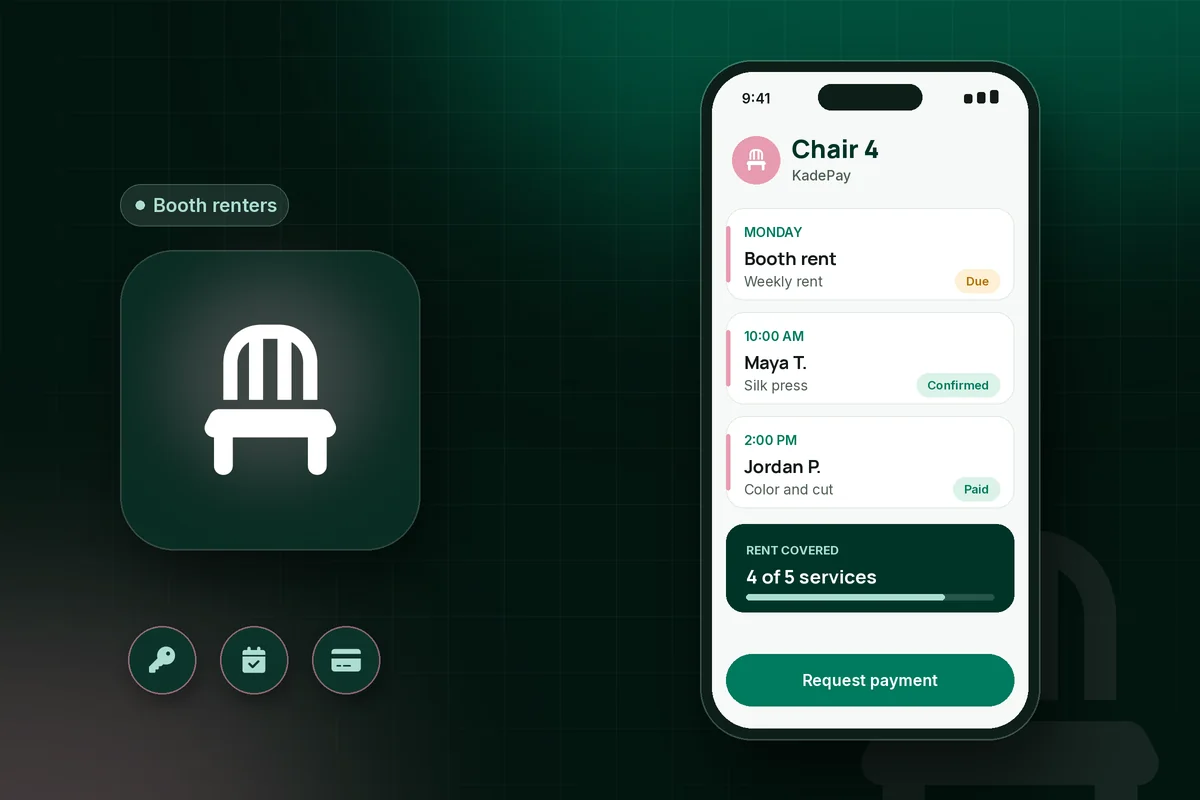
Salon booth rent is a fixed fee a licensed stylist pays a salon owner for a chair and station, usually weekly or monthly. The renter then runs an independent business inside the salon, setting their own prices, hours and payments, and paying their own costs and taxes.
This guide covers how booth rent works from start to finish. If you are still deciding whether to leave a commission job, the booth rent vs commission guide walks through that comparison. If you want a private room instead of a chair on a shared floor, see the guide to renting a salon suite.
How does salon booth rent work?
Booth rent works like a small lease: you pay the salon owner a set amount for the right to use one station, and everything you earn from your own clients is yours. The salon is your landlord, not your employer.
In a typical setup, the renter:
- Books their own clients and sets their own service prices
- Takes payment directly, into their own business account
- Buys their own color, tools and retail stock, unless the agreement says otherwise
- Carries their own insurance and keeps their own license current
- Pays rent on the due date whether the week was busy or slow
The salon owner provides the space, utilities and shared areas, and sets the house rules that apply to everyone, such as opening hours, cleanliness and noise.
What is usually included in booth rent?
Inclusions vary from salon to salon, so treat this table as a list of questions to ask, not a standard.
| Usually included | Sometimes included | Usually yours to supply |
|---|---|---|
| Styling chair, station and mirror | Backbar shampoo and conditioner | Color, chemicals and styling product |
| Shared shampoo bowls and dryers | Front desk help or a shared phone line | Tools: shears, irons, dryers, clippers |
| Utilities and building maintenance | Laundry and towels | Liability insurance |
| Restroom and waiting area | Wi-Fi and a shared music system | Booking and payment software |
| A key or access code during set hours | Listing on the salon's website or signage | Business cards, ads and your own marketing |
Two items cause the most surprises: backbar product and front desk help. If the agreement does not mention them, assume they are not included.
How is booth rent charged?
Booth rent is usually a flat weekly or monthly fee, and some salons use a hybrid of a base rent plus a percentage of service sales. The structure matters as much as the amount, because it decides what you owe in a slow week and in a busy one.
These examples are illustrative, not market rates.
| Structure (illustrative) | How it works | Example |
|---|---|---|
| Flat weekly | Same amount every week, often due on a set weekday | $240 a week |
| Flat monthly | One payment a month, often due on the 1st | $240 x 52 / 12 = $1,040 a month |
| Hybrid | A lower base rent plus a share of sales above a set level | $150 a week + 10% of weekly service sales over $1,500 |
In the hybrid example, a week with $2,000 in service sales costs $150 + 10% x ($2,000 - $1,500) = $150 + $50 = $200. A week with $1,200 costs only the $150 base. A hybrid can soften slow weeks, but it also means the salon sees your sales numbers, so ask how they will be reported and checked.
Watch for a monthly figure quoted as "four weeks." Four weekly payments of $240 is $960, but a year has 52 weeks, not 48, so weekly rent really averages $1,040 a month.
How much does booth rent cost in total?
The real cost of booth rent is the rent plus every business expense the salon used to cover for you. Rent varies widely by city and salon, so get written quotes from two or three salons near your clients and fill in your own numbers.
This monthly budget is illustrative, not a market rate.
| Monthly cost (illustrative) | Amount | Notes |
|---|---|---|
| Booth rent | $1,040 | $240 a week x 52 / 12 |
| Color, chemicals and product | $300 | Rises and falls with how busy you are |
| Liability insurance | $40 | Annual premium divided by 12 |
| Booking and payment fees | $150 | Depends on your software plan and published card fees |
| Marketing | $70 | Cards, a printed price list, small ads |
| Tools, towels and small supplies | $50 | Replacing shears and irons over time |
| Total | $1,650 | $1,040 + $300 + $40 + $150 + $70 + $50 |
Rent is about 63% of this budget ($1,040 / $1,650). The other 37% is the part stylists most often leave out when comparing a booth quote to a commission paycheck.
How many clients do you need to cover booth rent?
Divide your monthly costs by your average ticket to find how many services cover them. Services needed = monthly costs / average ticket, rounded up.
These figures are illustrative and use an $80 average ticket.
| Goal (illustrative) | Monthly amount | Services a month | Services a week |
|---|---|---|---|
| Cover rent only | $1,040 | $1,040 / $80 = 13 | About 3 |
| Cover the full budget | $1,650 | $1,650 / $80 = 20.6, so 21 | About 4.8 |
| Full budget plus $3,500 for you before tax | $5,150 | $5,150 / $80 = 64.4, so 65 | About 15 |
Weekly figures use 4.33 weeks a month. Plan around the third row, and check it against a slow month, not your best one. To compare that result against what you would take home on commission, use the booth rent vs commission guide. A clear menu helps lift your average ticket, and the free salon price list maker can help you build one.
Booth renter vs employee: what is the difference?
A booth renter runs their own business, while an employee works under the salon's control and is paid by the salon. The label on the agreement does not decide it; the way the relationship actually works does.
The IRS says all evidence of control and independence must be considered, and groups it into three categories:
- Behavioral control. Does the salon control, or have the right to control, what you do and how you do it?
- Financial control. Does the salon control the business side, such as how you are paid, whether expenses are reimbursed and who supplies tools?
- Type of relationship. Are there written contracts or employee-type benefits, is the relationship ongoing, and is your work a key part of the salon's business?
| Booth renter | Salon employee | |
|---|---|---|
| Who pays whom | You pay the salon rent | The salon pays you wages or commission |
| Prices and schedule | You set them, within house rules | The salon sets them |
| Clients and booking | Yours | The salon's |
| Product and tools | Usually yours | Usually the salon's |
| Taxes | You file as self-employed | The salon withholds tax |
| Benefits | None from the salon | May be offered |
If a salon sets your prices, assigns your clients and controls your schedule while calling you a renter, the arrangement may not hold up. Where the answer is unclear, the IRS says either the business or the worker can file Form SS-8 to ask the IRS to decide. Your state may apply its own tests too, so ask your state labor agency or a professional.
How are booth renters taxed?
Booth renters are generally taxed as self-employed people, which means no tax is withheld from what clients pay you. This section is a high-level overview, not tax advice; ask a tax professional about your situation.
- Schedule C. Sole proprietors report business income and expenses on Schedule C (Form 1040). The Schedule C instructions place rent on other business property, such as office space, on line 20b.
- Self-employment tax. The IRS says you must pay self-employment tax if your net earnings from self-employment are $400 or more. The rate is 15.3%: 12.4% for Social Security and 2.9% for Medicare, reported on Schedule SE. You can deduct the employer-equivalent portion of that tax when figuring adjusted gross income.
- Estimated taxes. Sole proprietors generally have to make estimated tax payments if they expect to owe $1,000 or more when they file, according to the IRS. Most individuals use Form 1040-ES.
Keep the booth agreement, every rent receipt and a record of every payment you take, by card, app or cash. Clean records make quarterly estimates and year-end filing much faster.
What licenses does a booth renter need?
You need a current cosmetology or barber license in your state, and you may need more, depending on where you work. The U.S. Small Business Administration notes that the licenses and permits a business needs depend on its activities and location, and that state, county and city requirements and fees vary.
Before you sign, ask your state board of cosmetology or barbering:
- Whether booth renters need a separate license or registration
- Whether the salon's establishment license covers your station
- What has to be displayed at your station
Then ask your city or county whether you need a local business license, and your state tax agency whether retail product sales need a sales tax registration.
For insurance, the SBA describes general liability insurance as covering bodily injury, property damage and related claims, and professional liability as covering errors and negligence for service businesses. Some salons require renters to carry specific coverage and show proof, so check the agreement.
What should a booth rental agreement include?
A booth rental agreement should spell out the rent, the due date, what is included, the hours you can work, your independent status, insurance, and how either side can end it. Read it before you pay a deposit, and have a local attorney review it.
At a minimum, look for: the parties and the station, the term, rent and due date, late fees, security deposit, inclusions, access hours, independent contractor status, client and pricing control, insurance, licensing, retail rules and termination notice. The salon booth rental agreement guide goes clause by clause and includes a sample agreement to adapt.
How to take bookings and payments as a booth renter
As a renter, bookings and payments should run through your own business, not the salon's front desk or register. That keeps your client list yours and your records clean at tax time.
- Publish your own booking link. In KadePay, clients request an available time through your booking link. Each request arrives as tentative, and you review and confirm it before it counts as booked. Submitting a request does not create a bill or take payment.
- Confirm requests promptly. KadePay does not send reminders while an appointment is still tentative, so confirming quickly matters. Free appointment reminder templates can help with your own messages.
- Take payment your clients' way. KadePay supports payment links and text-to-pay, Tap to Pay on an eligible phone, and card terminals available to purchase. You can also accept Venmo and Zelle; those payments happen outside KadePay, and you verify you received them.
- Know your card costs. Card processing fees are published on the KadePay pricing page and differ between terminal and manual entry. The credit card fee calculator shows what fees cost on your own ticket sizes.
- Plan for no-shows. An empty slot still costs you rent. The guide to reducing salon no-shows and the non-refundable deposit guide cover policies that protect long services.
KadePay's Pay-As-You-Go plan is $0 a month and includes 60 appointment bookings each month, then $0.15 per booking; usage and payment fees apply. You can start free with KadePay before your first week in the chair. More on tools for independent stylists is on the KadePay page for hairstylists.
When booth rent is not the right fit
Booth rent is a poor fit if your regular clients would not cover your full monthly budget plus your own pay in a slow month. It is also a hard start for a newly licensed stylist who still needs walk-ins, education and a salon's steady flow of new clients. If you want benefits, paid time off or someone else handling booking and payments, a commission or salaried job may suit you better. If you want privacy and full control of the space and can carry a higher rent, a suite may fit better than a booth.
Related reading
- Booth rent vs commission: which pays hair stylists more?
- Renting a salon suite: costs, pros and cons, what to ask
- Salon booth rental agreement: what to include
- Hair stylist app guide
- No-show calculator (free tool)
Sources
- Internal Revenue Service, Independent contractor (self-employed) or employee?, accessed November 23, 2026.
- Internal Revenue Service, Self-employment tax (Social Security and Medicare taxes), accessed November 23, 2026.
- Internal Revenue Service, Estimated taxes, accessed November 23, 2026.
- Internal Revenue Service, Instructions for Schedule C (Form 1040), accessed November 23, 2026.
- U.S. Small Business Administration, Apply for licenses and permits, accessed November 23, 2026.
- U.S. Small Business Administration, Get business insurance, accessed November 23, 2026.
This article is general information, not tax or legal advice.