Skip to content
KadePayGet started

KADEPAY FOR HOME CARE AGENCIES

Private pay home care billing that is easy for families to pay.

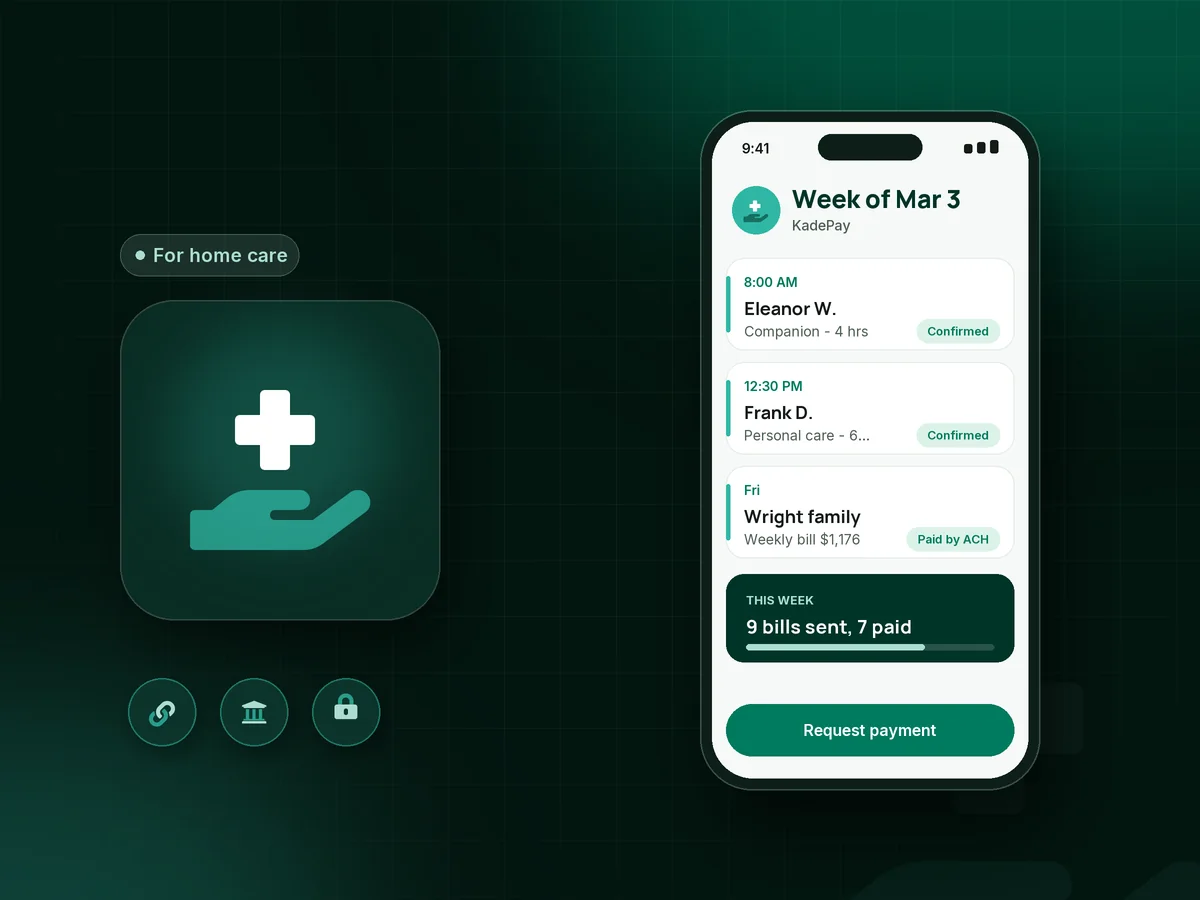
Care happens in your clients' homes every day, and the bill often goes to an adult son or daughter two states away. KadePay sends weekly care bills by text or email, collects by bank transfer or authorized card, and keeps service agreements and practical home notes with each client.

Pay-As-You-Go starts at $0 per month. Usage and payment fees apply.

Illustration of private pay home care billing in KadePay with a weekly care bill, a family bank payment and caregiver visits

Sound familiar?

You were hired to care, not to collect.

Private pay agencies cover caregiver wages every week and then wait on families to pay. These are the billing moments home care owners describe most often, and how KadePay takes the friction out of each one.

01

Weekly invoices that sit unopened in a relative's inbox

The daughter who pays for her mother's care is busy, the PDF invoice gets buried, and you are covering three weeks of caregiver hours.

With KadePay

Send each week's bill by text and email with reminders turned on. The family opens the link and pays by bank transfer or card in a couple of taps, and you see every payment in one list.

Ways to get paid
02

Large weekly amounts and card fees that add up

A 40-hour week of care is more than $1,000, and absorbing the card fee on every one of those bills eats into an already thin margin.

With KadePay

Offer ACH bank transfer to families who prefer it, and pass eligible credit card fees on to families where permitted. Families who already use Zelle can keep doing so, and you record the payment with no KadePay fee.

Venmo, Zelle and cards
03

Starting care before anything is signed or paid

A hospital discharge means care starts tomorrow, and the service agreement and deposit are still on the to-do list a week later.

With KadePay

Send your service agreement, client rights notice and payment terms as forms the family signs on their phone the same day, plus a deposit link for the amount your agreement sets.

Forms and signatures
04

Families who want to stop thinking about the bill

Some families ask you to just charge them each week, but keeping their card number in a folder at the office never felt right.

With KadePay

Ask the paying family member to authorize a saved card or bank account for current and future bills. They are notified of each charge and can revoke the authorization whenever they want.

Card on file
05

Door codes and routines buried in a group text

Which door to use, where the spare key lives, when the dog needs to go out: it all sits in old texts a new caregiver cannot find.

With KadePay

Keep practical details in private notes on each client profile, such as entry instructions, parking and preferred visit times. Notes stay with your team and are never shown to the family.

Customer profiles and notes

How it fits your week

How a private pay care week runs in KadePay

  1. A family reaches out

    An adult child requests an in-home consultation through your booking link. You confirm the time, and the visit is set at the client's address rather than your office.

  2. Agreement, deposit and payment method

    The family signs your service agreement on their phone, pays the starting deposit and authorizes a card or bank account for the weekly bills.

  3. Visits on the calendar

    Each visit sits on your calendar with its own location and the caregiver assigned, and automatic appointment reminders let the family know when care is coming.

  4. The weekly bill goes out

    At the end of the week, send one bill for the hours delivered by text and email with reminders. For families who authorized a saved method, charge it and they get a receipt.

  5. Records your bookkeeper can use

    Download transactions for your bookkeeper, and find each family's payment history on the client profile when questions come up at the end of the month.

Every way your clients pay

  • Visa
  • Mastercard
  • American Express
  • Discover
  • Apple Pay
  • Google Pay
  • Tap to Pay
  • ACH bank transfer
  • Affirm, where eligible
  • Venmo
  • Zelle
  • QR codes
  • Text and email links

Availability depends on your account setup and eligibility. You confirm Venmo and Zelle payments after checking they arrived.

KadePay for home care

Private pay home care billing that respects families and your cash flow

Private pay agencies live on weekly cash flow. Caregivers are paid on a schedule, while home care agency payments arrive whenever a family gets around to the bill. The gap between those two dates is where small agencies feel stretched, and it is the part KadePay is built to shorten.

Home care invoicing works best when the bill is easy to open and easy to pay. Weekly invoices for families by text and email, with reminders, beat a PDF that needs a check and a stamp. Bank transfer keeps large weeks affordable to collect, and an authorized card or account on file means families who prefer it never have to think about the bill again.

A signed home care service agreement and a home care deposit before the first shift set expectations from day one. Independent caregivers can use the same tools: a caregiver invoice sent from your phone and paid by card or bank transfer works whether you have one client or twelve.

KadePay is an in-home care payment app for the private pay side of senior care billing. It does not bill Medicaid, the VA or long-term care insurers, and it does not handle EVV or caregiver wages, so agencies with those payers keep their existing systems for that work.

CLEAR ANSWERS

Home care & caregivers: your questions, answered.

What is the best home care billing software for a private pay agency?

For private pay clients, look for bills families can pay from a text, bank transfer for large weeks and a card on file with real consent. KadePay does that, plus signed service agreements and visits on a calendar. Agencies with Medicaid or VA clients keep a dedicated system for those payers.

How do families pay for home care through KadePay?

You send a bill for the week by text or email. The family member who handles the money opens the link and pays by bank transfer, card, Apple Pay or Google Pay. If they authorize a saved method, you can charge it each week and they receive a receipt.

Can a home care agency charge a deposit before care starts?

Yes. Send a fixed-amount link or a bill for the deposit your service agreement sets, for example one week of care. Put the deposit terms in the agreement the family signs as a form, so everyone knows how it is applied or returned when care ends.

Does KadePay handle Medicaid, long-term care insurance or care records?

No. For home care, KadePay is limited to payments, booking requests, forms, packages and business notes, not clinical or medical records, care plans or claims to Medicaid, the VA or insurers. Use private notes only for practical details like entry instructions and parking, and keep care documentation in your care management system.

How do independent caregivers send a caregiver invoice?

Create a bill in the KadePay app with the hours and rate, for example 18 hours at $30, and send it by text. The family pays from the link with a card or bank transfer, or sends Zelle and you record it with no KadePay fee.

What does KadePay cost for a small home care agency?

A new agency can begin on Pay-As-You-Go at $0 per month, with payment and usage fees on transactions. Recurring bills and team logins come with Team at $10 per month or Pro at $35 per month, and the pricing page explains each plan.

YOUR WORK COMES FIRST

Make room for more clients.

Get started for free